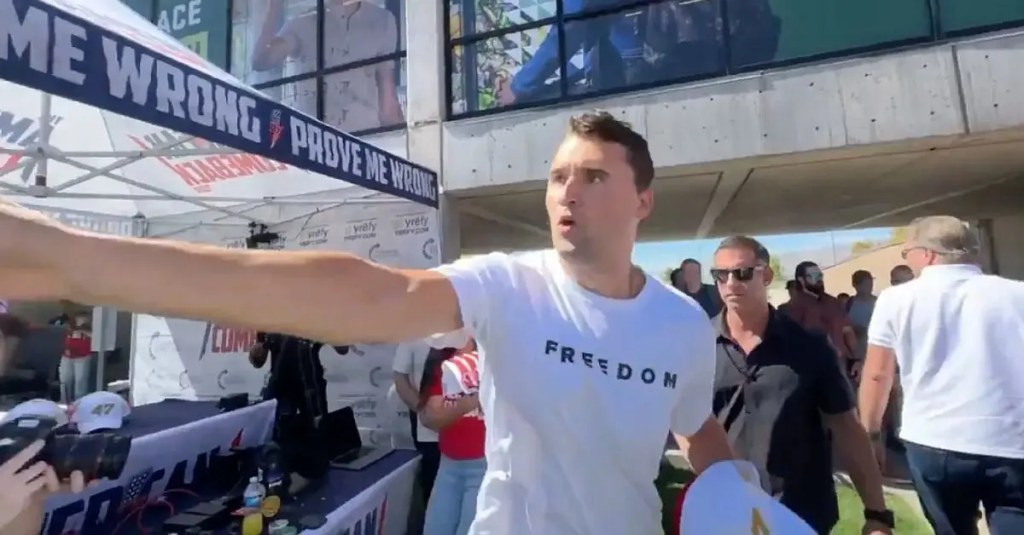
America stands at a crossroads. The violent assassination of Charlie Kirk, co-founder of Turning Point USA, is not only the silencing of a man but a sobering reminder that freedom itself is under attack. He was murdered for his political opinion — for the simple act of standing before an audience and saying what he believed.
Charlie Kirk’s story began in Arlington Heights, Illinois, far from the stages and television studios where he would one day become a household name. Raised in a modest, middle-class family, he was taught the values of faith, discipline, and persistence. He did not come from privilege, nor did he inherit a ready-made platform. Instead, he built one from the ground up.
As a teenager, Kirk was outspoken. He challenged teachers, debated peers, and threw himself into political study. At just 18 years old, he founded Turning Point USA with little more than determination and a laptop. What began as a handful of students handing out flyers on campus lawns grew into a national force with chapters at colleges and high schools across America.
By 2016, his determination had carried him all the way to the national stage. At 22, Charlie Kirk became the youngest person who had spoken at the Republican National Convention. That moment symbolized his emergence as a new voice for his generation — a leader unafraid to step forward and be heard.
By his twenties, TPUSA was a national force. Kirk organized massive conferences in Phoenix and across the country, drawing thousands of young people eager to engage. He launched podcasts, built a digital media empire, and became a sought-after speaker on television and at rallies. His message was unapologetic, his style combative yet engaging. He had tapped into something few could: the restlessness of a generation that felt ignored.
Charlie Kirk gave that generation a microphone. He told them their convictions mattered. He told them to speak without fear. And he proved that a movement could be built not from institutions or endowments, but from sheer will.
Yet he knew the risks of the life he chose. In today’s polarized climate, he was a lightning rod. His speeches drew packed crowds, but also protests. His words could inspire cheers or provoke anger. He lived with the knowledge that by standing so visibly for what he believed, he made himself a target. Still, he pressed forward.
Charlie chose to do what only a select few can, or are willing to do: he stood up and insisted on being heard. He embraced the arena of debate, knowing that the cost of conviction might one day be his own life.
Charlie Kirk’s causes were wide-ranging but rooted in what he saw as core American values: free markets, limited government, and individual responsibility. He was relentless in his advocacy for the First Amendment, believing that without free speech, no other right could survive.
He was also a passionate and steadfast supporter of Israel, seeing in its history and resilience a parallel to the endurance of freedom itself. For Kirk, standing with Israel was not a political position but a moral imperative. His critics called him polarizing. His supporters called him inspiring. But no one could call him timid. Charlie Kirk spoke with fire because he believed the stakes demanded it.
Charlie was just weeks away from his 32nd birthday when his life was cut short by an assassin’s bullet. He died in the very setting where he thrived: on a university campus, speaking to students, challenging them, encouraging them, and inviting them to debate.
We mourn with his wife, Erika, and his young children. Their grief is compounded by the cruel reality of the digital age: his violent end will forever live online, replayed endlessly, impossible to escape. For his children, the memory of their father will always carry that shadow — yet they will also carry the legacy of a man who refused to be silent.
Like Abraham Lincoln, Malcolm X, Martin Luther King Jr., John F. Kennedy, and Robert F. Kennedy, Charlie Kirk’s life was violently snuffed out because he refused silence. His assassination marks not just the end of a life but a turning point in the nation’s story.
We are left to ask: How can we claim to live in the land of free speech if a man is killed for saying what he thinks? How did we get here — to a place where ideas are answered with violence, where debate is cut short by gunfire, and where tolerance for difference collapses into hatred? The America we know has truly taken a turn
The name of his movement, Turning Point, now carries a prophetic weight. His death is itself a turning point — a test of whether America will continue down a path where violence decides who can speak, or whether we will choose a better road where dialogue, courage, and freedom remain the lifeblood of democracy.
Charlie Kirk has joined the tragic roll call of those who gave their lives for their beliefs. Whether you agreed with him or not, you cannot deny what he accomplished, how he did it, and the courage it took. He gave a generation a voice. He stood up when others stayed seated. He embraced risk so that others might embrace conviction.
He has now died for what he believed.
And so the question becomes not only how we will remember Charlie Kirk, but how we will respond. Will we honor his memory by protecting speech, by rejecting violence, and by carrying forward the courage he embodied? Or will we allow hatred to have the final word?
The America we know has truly taken a turn for the worse. We are reminded of political witch hunts and killings carried out simply for speaking one’s mind. What once were ideals of liberty and open dialogue now seem increasingly fragile, threatened by a culture of division that treats conviction as a crime.
Charlie Kirk’s life was a turning point. His death must be one too. Rest in Peace Charlie.
 RibotskyInstitute.com
Leave a comment