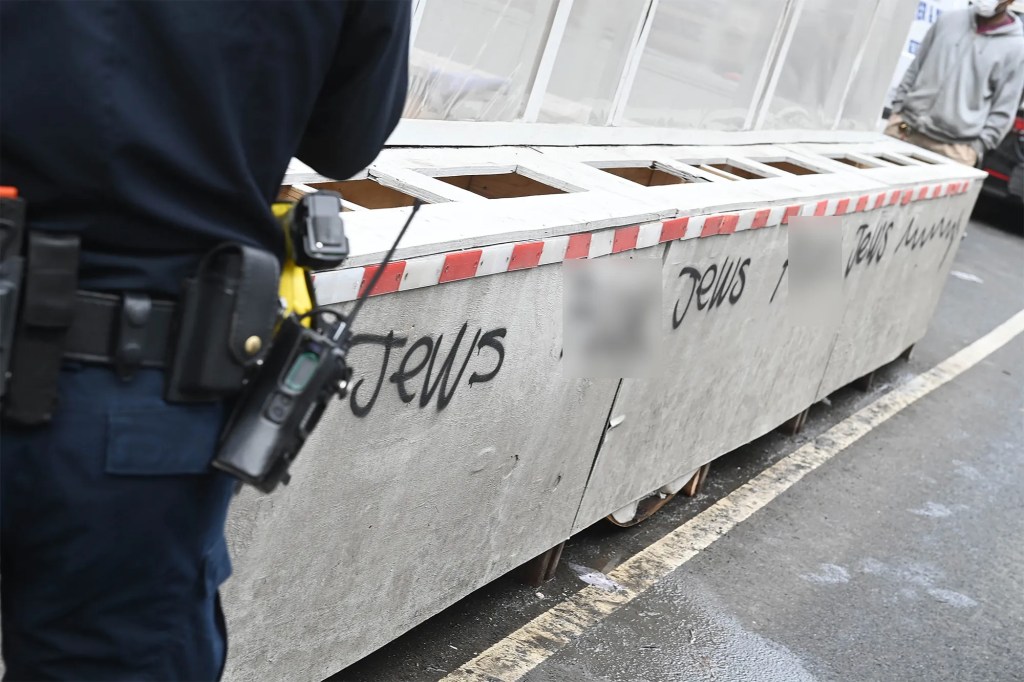
New York City has long been a place where Jewish life is visible, active, and publicly affirmed. For generations, Jews came to this city not because it was perfect, but because it was possible—to live openly, build institutions, argue loudly, disagree politically, and still expect basic physical safety and civic protection. That assumption is no longer universal. What is changing in New York is not merely the number of antisemitic incidents, but the way those incidents are explained away, minimized, or contextualized into irrelevance.
Antisemitism in New York is no longer shocking. That is the problem.
Over the past year, Jewish New Yorkers have been confronted with repeated acts of direct aggression. In Brooklyn, a Jewish man was stabbed during an encounter that escalated from verbal hostility into physical violence, prompting a police investigation into whether the attack constituted a hate crime. Around the same time, separate incidents on New York City subways involved Jews being harassed, threatened, and targeted while riding public transit, including confrontations in which antisemitic language was used openly in crowded cars. These were not abstract expressions of bias or online rhetoric. They were physical, in-person acts directed at identifiable Jewish individuals in ordinary public settings.
Yet the response pattern was familiar. Initial official descriptions were cautious. Motive was deferred. Language was neutralized. The incidents were treated as isolated events rather than manifestations of a broader and increasingly visible problem. Only later did the possibility of antisemitic intent receive acknowledgment, and even then with restraint.
This is not a matter of semantics. Language shapes response. When a stabbing of a Jewish man is approached first as a generic assault, or when harassment on public transit is folded into generalized disorder, the specificity of antisemitism is erased. That erasure functions as normalization. It tells Jewish residents that what they experienced may not warrant immediate recognition, let alone urgency.
The cumulative effect is real. Jewish New Yorkers adjust behavior. Parents think twice about where their children wear religious symbols. Individuals choose silence over confrontation on the subway. Synagogues and schools divert resources toward security rather than community life. None of this requires mass violence to take hold. It requires only repetition without clear accountability.
What has unfolded in New York mirrors developments elsewhere. This past week in Australia, that progression culminated in catastrophic violence. A Jewish gathering was attacked in what authorities described as an antisemitic mass-casualty assault. The victims were targeted not because of political activity, but because they were Jews gathered openly and publicly. The attack forced immediate and unequivocal recognition of antisemitism as the motive, eliminating the ambiguity that often precedes action.
The difference between New York and Australia is not moral clarity, but timing. In Australia, clarity came after bloodshed made denial impossible. In New York, clarity is still treated as something to be determined later. That is precisely the danger. Antisemitism rarely announces itself with a single defining event. It advances through incremental tolerance, delayed acknowledgment, and institutional discomfort with naming the problem plainly.
Political leadership plays a role here not through overt hostility, but through hesitation. When officials respond to antisemitic aggression with generalized statements about “hate in all forms,” they avoid specificity. When enforcement and messaging lag behind events, communities notice. Ambiguity communicates tolerance, even when that is not the intent.
This is not a partisan critique. Antisemitism does not belong to one ideology, and responsibility for addressing it does not either. What is consistent across contexts is the expectation that Jewish communities will endure more, explain more, and wait longer before their experiences are taken at face value.
New York is not beyond repair. It remains a city with strong Jewish institutions and public officials who state opposition to antisemitism. But opposition in principle is no longer sufficient. Protection delayed is protection denied. Condemnation without clarity is ineffective.
The stabbing of a Jewish man in Brooklyn, the targeting of Jews on New York City subways, and the massacre in Australia are not disconnected events. They exist along the same continuum. Each reflects what happens when antisemitism is treated as conditional, contextual, or inconvenient to name.
The question facing New York is not whether it condemns antisemitism in theory. It always has. The question is whether it is willing to recognize the pattern while it is still forming, rather than waiting for escalation to force recognition. History shows that antisemitism does not begin with mass violence. It begins with hesitation, with normalization, with the quiet decision to treat hostility toward Jews as tolerable so long as it remains intermittent, localized, or politically inconvenient to confront.
That progression is not speculative. It is documented. Jews in Europe were not immediately targeted with extermination. They were harassed, isolated, blamed, and gradually removed from public protection while institutions reassured themselves that the situation was manageable, contextual, or temporary. Violence came later, after the moral baseline had already eroded and after indifference had done its work.
No serious observer is claiming that New York is 1930s Europe. The lesson is more basic and more uncomfortable: societies do not stumble into catastrophe by accident. They arrive there by dismissing early warning signs, by postponing clarity, and by convincing themselves that things are not yet bad enough to require decisive action. When antisemitic aggression is treated as background noise—whether on a subway car, a street corner, or outside a synagogue—the conditions that allow escalation are quietly set.
If New York intends to remain a city where Jewish life is not merely present but secure, it must reject that pattern now. Antisemitism does not need permission to grow. It only needs delay. History has already shown where that road leads, whether people choose to pay attention or not.
Shabbat Shalom……….
 RibotskyInstitute.com
Leave a comment