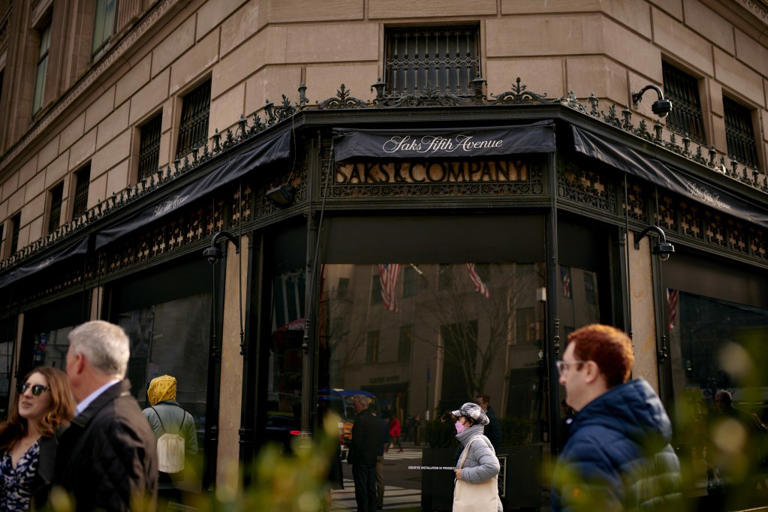
If reports are correct that Saks Fifth Avenue, through its parent structure, is preparing for a Chapter 11 filing after missing a massive interest payment tied to its acquisition financing, this should not be treated as a sudden deterioration or an unfortunate turn of events. It is the predictable outcome of trying to solve a structural collapse in high-end retail with leverage, consolidation, and financial engineering. The merger of Saks with Neiman Marcus, along with Bergdorf Goodman, was never a strategy for the future of luxury. It was a bet that the past could be scaled, refinanced, and made relevant again.
The logic behind the merger was straightforward and deeply flawed. Two legacy luxury department stores, each struggling with declining foot traffic, shrinking relevance, and rising operating costs, were combined under the theory that scale would create leverage. Shared vendors, consolidated back offices, combined purchasing power, and operational synergies were supposed to offset secular decline. But scale only matters when the underlying business model is still desired by the market. In luxury retail, that premise has been eroding for more than a decade.
Luxury brands no longer need department stores. That is the central fact the merger failed to confront. The most powerful fashion houses and designers have spent years deliberately pulling inventory away from wholesale partners and reinvesting in their own boutiques, their own digital platforms, and their own direct relationships with customers. This shift is not primarily about saving a few margin points. It is about control. Control of pricing, control of brand narrative, control of customer data, and control of experience. Department stores, by definition, dilute all of those things.
By merging Saks and Neiman Marcus, the combined entity did not gain power over brands. It became more dependent on them at precisely the moment brands were least willing to depend on department stores. The merger concentrated exposure to a wholesale model that luxury has been systematically abandoning. Instead of creating a moat, it magnified the same vulnerability across a larger balance sheet.
Debt turned that strategic weakness into a crisis. The acquisition was heavily leveraged, and leverage is unforgiving in fashion retail. Luxury retail is cyclical, seasonal, and inventory-driven. Liquidity matters more than almost anything else because inventory must be bought months in advance, paid for on tight schedules, and sold in narrow windows. Once questions arise about a retailer’s ability to pay vendors, the consequences cascade immediately. Vendors tighten terms, reduce shipments, or divert product to their own stores and healthier partners. In luxury, merchandise shortages are not an inconvenience. They are existential.
When customers walk into a luxury department store, they are not browsing generically. They are looking for specific designers, specific items, and specific seasonal collections. If those are missing, the visit ends quickly and often permanently. Foot traffic declines follow, not because demand for luxury disappears, but because the department store no longer offers anything unique or reliable. That decline feeds back into cash flow stress, which in turn further erodes vendor confidence. The more this occurs the more the spiral accelerates.
This is exactly the dynamic that played out during Neiman Marcus’ prior bankruptcy. That filing was often framed as a pandemic-era anomaly, but it was not. It was an early warning that the luxury department store model cannot sustain leverage in an environment where brands and consumers have alternatives. Neiman emerged from bankruptcy with reduced debt, but it did not emerge with a reinvented role in the luxury ecosystem. As a matter of fact, nothing in Neiman Marcus’ strategy changed. Saks did not fix that problem by acquiring Neiman. It inherited it.
The broader retail data reinforced these structural issues long before any missed interest payment. Foot traffic trends for both Saks and Neiman Marcus had been declining year over year, even as luxury spending overall remained resilient. That divergence is critical. Luxury did not collapse. The channel did. High-end consumers continued to spend, but they spent differently. They spent directly with brands, through curated experiences, through private client relationships, and through platforms that offered personalization rather than scale.
This reflects a deeper cultural shift. The department store once functioned as an arbiter of taste and aspiration. It curated, introduced, and validated luxury. That authority no longer exists. Discovery now happens digitally and socially. Influence flows through creators, private events, brand-hosted experiences, and peer signaling. The department store is no longer the gateway. It is a middle layer that adds cost without adding meaning.
The merger attempted to optimize that middle layer rather than eliminate or radically reinvent it. Cost reductions, centralized operations, and financial restructuring cannot restore cultural relevance. They can only delay the consequences of its absence. When the balance sheet is strained, delay becomes impossible.
What is unfolding now is not a referendum on luxury itself. Luxury is thriving globally. What is ending is the assumption that large, multi-brand American department stores are essential to its distribution. The Saks–Neiman merger was not a forward-looking consolidation. It was a defensive maneuver designed to buy time. That time has now run out.
If bankruptcy occurs, it will not represent failure in the traditional sense. It will represent recognition that the model, as currently structured, cannot survive. The real failure was believing that merging two declining institutions could reverse a secular shift in how luxury is created, sold, and consumed.
High-end retail is not disappearing. It has already moved on.
 RibotskyInstitute.com
Leave a comment