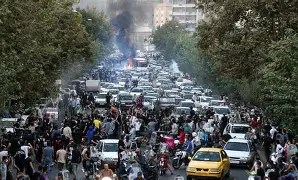
As Iran’s streets erupt in what may be the most consequential uprising since the 1979 revolution, one question looms larger than the demonstrations themselves: where are the world’s human-rights activists now?
Across all 31 provinces, Iranians are risking imprisonment, torture, and death to challenge a theocratic regime that has ruled for 45 years through fear, censorship, and violence. These are not symbolic protests. These are not campus rallies or social-media campaigns. This is real revolution—born of economic collapse, political suffocation, and a population that has reached the breaking point.
And yet, much of the Western activist class is silent.
That silence becomes impossible to ignore when contrasted with the speed and intensity of recent mass protests across the United States and Europe—demonstrations that did not arise to confront authoritarian regimes or defend universal human rights, but instead mobilized on behalf of Hamas, a U.S.-designated terrorist organization that openly celebrates mass murder, hostage-taking, and the deliberate targeting of civilians.
Let’s dispense with a critical falsehood that fueled those protests: Palestinians were not facing displacement in the way activists claimed. What occurred was a coordinated terrorist attack by Hamas, followed by a predictable military response. Western demonstrators did not rise organically to defend civilians; they adopted Hamas’s narrative wholesale—often erasing October 7 entirely, chanting slogans that excused terror as “resistance,” and treating complexity as heresy.
That was not human-rights advocacy. It was ideological theater.
Now look at Iran.
There is no terrorist organization to romanticize. No fashionable slogans. No clean oppressor-versus-victim framing that fits neatly on a poster. Instead, there are shopkeepers, students, and workers chanting openly for the end of clerical rule. There are internet blackouts to conceal state violence, live ammunition fired into crowds, and arrests designed to terrorize families into silence.
And still—no marches. No encampments. No viral outrage.
Perhaps the most revealing image to emerge from Iran’s uprising captures this hypocrisy in a single frame: protesters symbolically renaming a street after Donald Trump.
This was not an official act. It was not sanctioned. It was an act of defiance—Iranians taping up makeshift signs in the middle of a revolt, signaling not ideology but desperation. A plea to the outside world. A rejection of decades of regime-imposed anti-American propaganda in favor of whatever leverage they believe might help them survive.
Whether one supports Trump or despises him is beside the point. The symbolism is unmistakable. These protesters are not performing politics; they are grasping for freedom. They are appealing outward because no internal mechanism for reform exists. That image alone should have shattered the tidy narratives that dominate Western protest culture.
Instead, it was largely ignored.
Why? Because Iran’s uprising doesn’t flatter fashionable ideology. It doesn’t fit neatly into a framework where the West is always the villain and anti-Western actors are automatically the oppressed. It exposes something many activists would rather not confront: that their outrage is selective, their empathy conditional, and their principles negotiable.
When Iranian women are beaten or killed for violating dress codes, there are no global marches. When protesters are executed for speech crimes, there are no celebrity statements. When the internet is shut off so a regime can kill quietly, there are no tent encampments demanding accountability.
But when a terrorist organization commits mass murder and frames itself as anti-Western, the streets fill overnight.
That inversion is not accidental. It is the product of a protest culture that has drifted away from universal human rights and toward ideological alignment. Causes are no longer judged by moral clarity but by whether they fit a preferred narrative. If the oppressor is Western-aligned, outrage is automatic. If the oppressor chants “Death to America,” suddenly everything becomes complicated.
Iran lays bare that hypocrisy.
The people in Tehran, Mashhad, Isfahan, and Shiraz are not asking for hashtags. They are not staging protests for applause. They are risking everything to dismantle a regime that has crushed dissent for nearly half a century.
If the global protest movement cannot recognize that struggle—while it readily mobilizes to excuse or sanitize terrorism—then it has forfeited any serious claim to moral authority.
Human rights are not a costume.
Solidarity is not a trend.
And revolutions don’t wait for approval from activists who only show up when the politics are comfortable.
And the silence isn’t limited to activists. Where is the mainstream media?
When protests erupted over Hamas’s war, the news went wall-to-wall. Panels ran nonstop. Headlines were instant, emotional, and uncritical. Editors framed events before facts were established and rewarded slogans over scrutiny.
But in Iran—where a genuine mass uprising threatens a 45-year theocracy—the coverage has been sporadic, muted, and quickly buried. There are no continuous live shots, no nightly countdowns of casualties, no breathless “breaking news” banners tracking the collapse of an authoritarian regime.
This isn’t because Iran lacks drama or consequence. It’s because Iran defies preferred narratives. A revolution against an anti-Western theocracy complicates the simplistic moral frameworks that much of the media has grown comfortable promoting.
The result is a quiet abdication of responsibility. By minimizing coverage, the media doesn’t just fail to inform—it actively shields the regime from sustained international scrutiny at the very moment when attention could matter most.
 RibotskyInstitute.com
Leave a comment