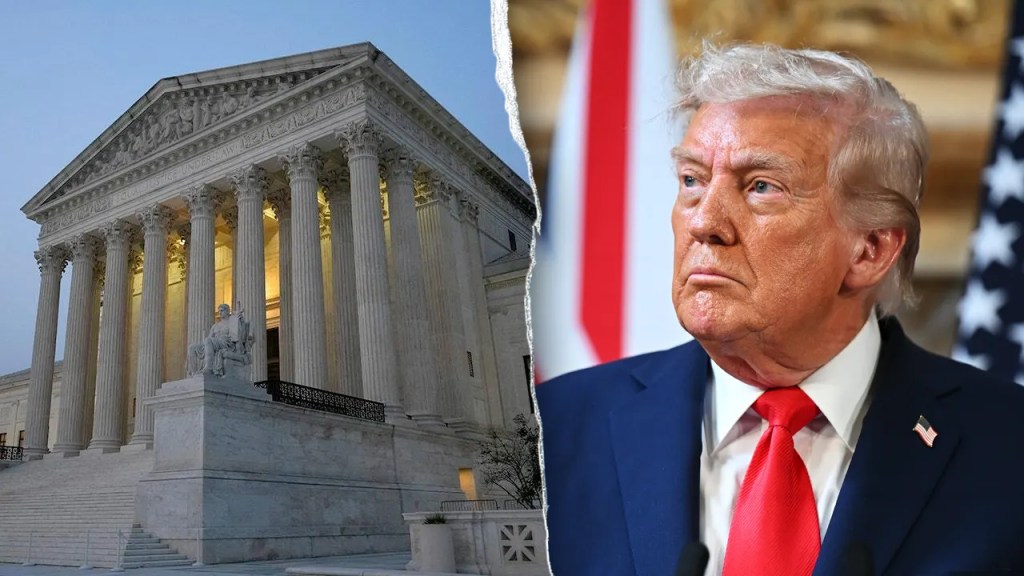
When the Supreme Court recently ruled on President Trump’s tariff program, the legal opinion had barely been released before headlines crystallized around a single narrative: a “blow to Trump,” a “rebuke of Trump’s trade agenda,” a “setback for tariff policy.” Within hours, political commentators on both sides amplified the story as another chapter in an ongoing partisan struggle.
That framing may generate clicks. It may energize audiences. It may reinforce existing political loyalties. But it fundamentally mischaracterizes what the Court actually decided.
The case was not about whether tariffs are good economic policy. It was not about whether tariffs strengthen domestic manufacturing. It was not about whether tariffs harm consumers or reshape global supply chains. The Justices were not asked to determine whether tariffs are an effective revenue tool for the United States.
They were asked something much narrower and far more technical: whether the statute the administration relied upon actually authorized the President to impose sweeping tariffs.
That is a question of delegated authority. It is not a question of economic wisdom. Yet much of the media coverage blurred that distinction, fueling a political narrative rather than explaining a legal one.
The Revenue Reality the Headlines Ignored
Any serious evaluation of the tariff program must acknowledge an undeniable fact: it generated substantial federal revenue.
By fiscal year 2025, customs duty collections had reached approximately $195 billion, the highest level in modern history. On a calendar-year basis, customs duties, taxes, and related fees approached $287 billion. Monthly tariff receipts climbed into the $27 to $30 billion range, compared to roughly $7 billion per month before the expansion of tariff policy.
Independent analysts estimated that the tariff regime produced roughly $194.8 billion in additional revenue above historical baselines. Longer-term projections suggested that if sustained, the tariff framework could generate approximately $247 billion in revenue in 2026 alone and potentially more than $2.3 trillion over a decade.
Tariffs, which historically accounted for less than 2 percent of federal revenue, rose to roughly 3 to 4 percent of total receipts.
These numbers are not political talking points. They are fiscal realities. The tariffs were not symbolic gestures. They materially altered federal revenue streams.
And yet, none of those figures were the subject of the Court’s ruling.
Revenue Is Not the Same as Authority
A policy can generate billions of dollars and still rest on questionable statutory footing. The Court’s role is not to measure revenue. It is to measure authority.
The tariffs at issue were imposed under the International Emergency Economic Powers Act (IEEPA), a 1977 statute designed to allow presidents to respond to foreign threats during national emergencies by regulating economic transactions. Historically, the statute has been used to freeze assets, block transactions, and impose sanctions.
The administration argued that IEEPA’s language authorizing the President to “regulate importation” during an emergency included the authority to impose tariffs. Opponents argued that tariffs are fundamentally taxes or duties, traditionally imposed by Congress, and that if Congress intends to delegate such power, it does so explicitly through trade statutes.
The Supreme Court agreed with the challengers. It held that IEEPA does not clearly authorize sweeping tariff authority.
Importantly, the Court did not say tariffs are unconstitutional. It did not say tariffs are economically harmful. It did not say tariffs cannot be used to generate revenue.
It said only that this statute did not clearly grant that authority.
The Major Questions Doctrine and Constitutional Structure
The Court’s reasoning relied in part on what has become known as the “major questions doctrine.” Under this principle, when executive action carries enormous economic and political significance, courts require clear congressional authorization.
Sweeping tariffs that affect global trade unquestionably fall into that category. Interpreting a broadly worded emergency statute to permit virtually unlimited tariff authority would represent a dramatic shift of legislative power to the executive branch.
The Court declined to make that interpretive leap. It concluded that if Congress intends to give the President that level of authority, it must say so explicitly.
This is not a political rebuke. It is a structural one. It reinforces the constitutional principle that Congress writes the laws and delegates authority clearly, rather than implicitly transferring sweeping power through ambiguous language.
The Media Narrative and the Political Divide
Why then did so much coverage portray the decision as an anti-Trump ruling?
Because political framing is easier than legal explanation.
It is simpler to describe a case as a partisan victory or defeat than to explain statutory interpretation, delegation doctrine, and separation of powers. It is more emotionally compelling to characterize a ruling as an ideological clash than as a technical dispute over statutory language.
But this framing has consequences. It reinforces the perception that every Supreme Court decision is inherently political. It deepens the divide between audiences who view rulings through partisan lenses. It shifts attention away from constitutional structure and toward political theater.
In reality, the legal analysis would have been identical regardless of which president invoked IEEPA in this manner. The Court’s reasoning did not depend on trade philosophy or party affiliation. It depended on statutory text and constitutional allocation of power.
By reducing the decision to a narrative of political victory and defeat, the media obscured the more important institutional principle at stake.
A Legal Shift, Not an Economic Judgment
There is no question that the ruling alters the legal pathway for broad tariff implementation under emergency powers. That is a significant development for any administration seeking to rely on IEEPA as a tariff vehicle.
But that legal shift is not an economic verdict. It does not resolve debates about whether tariffs improve America’s position in the global economy. It does not measure their fiscal impact. It does not weigh their strategic value.
Those debates remain squarely within the political branches.
The Court’s message was narrower: if tariffs are to serve as a major instrument of economic policy, Congress must clearly authorize that authority, or the President must rely on statutes that explicitly grant it.
The Larger Constitutional Point
The United States was designed with divided powers precisely to prevent the accumulation of authority in a single branch. When courts insist on clear delegation before allowing sweeping executive action, they are not entering political debates. They are preserving constitutional structure.
That structure does not favor or oppose any particular policy. It ensures that major economic decisions flow through the appropriate constitutional channels.
The revenue figures demonstrate that the tariff program had real fiscal weight. The Court’s ruling demonstrates that fiscal weight alone does not determine legality.
The distinction between economic outcome and legal authority may be less dramatic than partisan headlines. But it is far more important to the integrity of constitutional governance.
The Supreme Court did not decide whether tariffs are good for America. It decided whether Congress had clearly given the President the authority to impose them under this statute.
Everything else — including the media narrative — is political commentary layered on top of a legal ruling.
If we are serious about reducing polarization rather than amplifying it, we must begin by understanding that difference.
 RibotskyInstitute.com
Leave a comment